Showing posts with label Security. Show all posts

Sunday, October 11, 2015

Russia and Ukraine Links - Tanks and Missile Launchers Edition

A few weeks ago I put up some links about Russia and Ukraine (LINK).  I am adding to that collection again today. 

Russian tanks in the crisis (LINK).  It is getting harder and harder for Russia to deny that it is materially supporting the rebels in the breakaway region.  The article is a fascinating study in the use of open sources and social media to gather intelligence.  While this intelligence can be shared easily, since it doesn't involve disclosing classified sources or methods, the danger is that it feeds into the narrative of the Kremlin about US misinformation and propaganda regarding its role. Winning the propaganda game is very difficult for the defensive side. Not only are Russian tanks being used, but the training and showmanship associated with Russia.  Russia has been running tank olympics for the past few years, and the rebels did the same thing with their tanks a few weeks ago (LINK).

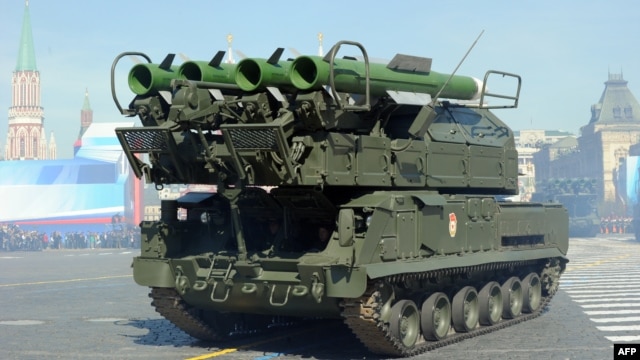
A Russian Buk-2M missile launcher is displayed on Red Square in Moscow during the Victory Day parade on May 9, 2013.

The same group that is finding evidence of Russian tanks and soldiers in Ukraine is releasing evidence of Russia's BUK missiles being used to shoot down the Malaysian Airlines jet in July 2014. (LINK).

Bellingcat, which analyzes information available on the Internet, said on October 8 that the Buk antiaircraft system involved in the incident can be traced from the Russian city of Kursk in June 2014 to a field outside the Ukrainian town of Snizhne in Donetsk Oblast on the day of the flight MH17 disaster. 
The next day, the launcher from the same Buk system -- with only three missiles instead of the normal compliment of four -- was documented to be near the Russian border in Luhansk Oblast, the report says. 
"We have looked at all the open-source investigation we've done over the last 18 months and it seems a pretty firm conclusion that the Russian military provided the missile launcher that shot down MH17, that the missile was launched from outside of Snizhne," Bellingcat founder and director Eliot Higgins says. "And we were able to track the Buk missile launcher back to the actual unit who provided it, the 53rd Brigade." 
Higgins added that Bellingcat has forwarded information about the individual members of the 53rd Brigade who might have been involved in shooting down MH17 to authorities investigating the incident.
 Is it any wonder that Ukraine now views Moscow as the main aggressor in their new military doctrine (LINK)? I mentioned in an earlier post about Russia's involvement in Syria that Putin is creating a self-fulfilling prophecy about the encirclement of Russia by NATO (LINKhttp://grimyard.blogspot.com/2015/10/russia-and-syria-arms-related-issues.html). He has only himself to blame.

Thursday, October 8, 2015

Russia and Syria - Arms Related Issues

Russia is now involved in the war in Syria.  Air strikes and naval bombardment along with cruise missile launches, along with the addition of ground troops as advisers is serious business.  The potential for adverse international incidents has increased.  The fighting in Ukraine is contained.  The fighting in Syria is taking place in the context of continued Western and US airstrikes.  The potential for a direct military confrontation between the US and Russia is higher than it has been for a long time.

I am interested in Russia's endgame here.  I am curious as to what Putin thinks he will gain. I just started reading a great book that analyzes Putin's actions, and this quote really jumped out at me:

"...we cannot take any story or so called fact at face value when it comes to Vladimir Putin ... we are dealing with someone who is a master at manipulating information, suppressing information, and creating pseudo-information...In today's world of social media, the public has the impression that we know, or can easily know, everything about everybody.  Nothing, it seems, is private or secret.  And still, after 15 years, we remain ignorant of some of the most basic facts about a man who is arguably the most powerful individual in the world, the leader of an important nation.  When there is no certifiably real and solid information, any tidbit becomes precious." [1]
This jumped out to me again when I watched the Daily Vertical podcast about Putin challenging the western world's way of thinking and facts (LINK).  While I don't think I have any really new insights into what Russia is doing and thinking, I can at least make some observations about the effects of what they are doing in an area that I do have some insights into: arms transfers.

Negative and Potential Negative Consequences for Russian Arms Sales

I have already covered the issue of the Mistral ships.  Russia lost these ships as a direct result of their actions in Ukraine.  The latest word is that Egypt is going to purchase these ships, which is good for France (LINK). Is there a potential that Russia will lose out on other purchases?  Yes, but Russia doesn't import a lot of equipment, so for them, this is just a temporary setback.

The more serious setback for Russia would be if states began cancelling orders for weapons after seeing their actions.  This is a real possibility.  Turkey is very upset at Russia over incursions into its air space as Russia began its air actions over Syria.  This has already had an effect on a joint pipeline project (LINK), and has the potential to damage other relations.  Russia and Turkey have cooperated on helicopter manufacturing in the past (a case study from my dissertation), and if Turkey sees Russia becoming a security risk, it will likely move away from such relations.

The performance of Russian equipment in Syria is also a potential negative side effect.  If Russian equipment performs poorly (like reports of four cruise missiles crashing in Iran instead of hitting targets in Syria (LINK)), then potential customers may decide to look for other options.

Potential Positive Consequences for Russian Arms Sales

There are two potential positive consequences of Russian actions in Syria from the point of view of Russian arms sales. The first is the converse of the last point made above: positive performance by Russian equipment is free advertising for Russian arms.  Seeing weapons tested in combat and working is a great selling point to potential customers.

Other current and potential customers will take note of the point above and may also see the arms relationship becoming a proxy for more formal alliances, thus making continued arms purchases, or new arms purchases more attractive to buyers.  Venezuela recently expanded its arms deal with Russia (LINK), as has Thailand (LINK).  Interestingly, the deal with Thailand appears to be a barter deal for rubber.  This could be an effect of sanctions.  Thailand has been diversifying its arms portfolio in recent years.

Potential Positive Effects for US Arms Sales

For the US, Russia being seen as an aggressor may potentially make arms sales to neighboring states a higher priority.  States will see this as a way to further integrate with existing US-led defense pacts (NATO), and a way to strengthen and emphasize military ties. Norway, for instance, recently added more planes to its F-35 order because of Russian aggression and escalation in the Baltic and North Sea areas (LINK).  This will be dependent on whether states are satisfied with US military hardware, however, which in some recent cases doesn't appear to be the case (LINK).

Other Geopolitical Consequences

Just because I am not going to spend time trying to figure out Putin's motivations, does not mean that I won't point out some geopolitical consequences of Russian military adventurism. The most obvious is that Russia's fears of NATO are now becoming a self-fulfilling prophecy as NATO moves to bolster its powers along Russia's borders and to strengthen commitments to states bordering Russia's active military adventures (Poland, Turkey) (LINK).  It is also leading, it appears, to a strengthening of the US resolve on the issue of Ukraine (LINK).

________
[1] Hill, Fiona and Clifford G. Gaddy. 2015. Mr. Putin: Operative in the Kremlin. Brookings Institution. p 7.
Tuesday, June 17, 2014

Iraq's new Civil War - Why Detention Matters.

Background

The past week has been interesting for me, sitting on the sideline and reading about detainees in Iraq.  The leader of the ISIS group that took over Mosul was released from Bucca in 2009.  The stories that are coming out about him now are primarily about how no one knows much about him.  The latest revelation is that he made a remark to the US soldiers releasing him to the effect that he would "See them in New York." That is a bit ominous given the stature of his group.  He is now the prime target of US forces. (See the following story for more background.)

My interest in this story comes from many sources. First, the news that Mosul had fallen deeply saddened me.  I was in Mosul from April to October 2003. I was stationed at the airfield there and worked as the leader of a Tactical Human Intelligence Team gathering information on threats to US forces and Iraqis in the area.  Mosul was very stable and pleasant during my time there. Mosul was the success that General Petraeus would capitalize on in his meteoric rise over the next decade.

Second, my next tour to Iraq in 2007-08 was to Camp Bucca.  Camp Bucca during the height of the surge was a contradiction.  It was an overcrowded mess (more than 25,000 detainees) of a camp that was simultaneously growing with the influx of detainees and working to reform the system to release them.  We hit a period of growth, and then the releases started.  The camp was run using doctrines from U.S. military incarceration, US Prisoner of War procedures, and a smattering of counterinsurgency.  The counterinsurgency aspects were taking root as we arrived.

Third, I have written on the subject of detention academically - and am one of the few political science scholars to do so. It is an area that has lacked attention in the past, but which now may become more obvious as a key aspect of conflict resolution, policy-making, and strategy.

Flawed System

One of the first papers I wrote as a graduate student dealt with the issue of releasing prisoners from detention centers.  The logic of the paper was simple. If detainees are properly classified using intelligence, the release of less dangerous detainees is sound policy.  However, the less certain we become about the classification of detainees, the more dangerous detainees will be released back into the fight.  This is a fairly obvious point, but it was made with my own personal experience in trying to classify detainees at Camp Bucca.  The fact is that we were not good at initially identifying dangerous detainees or updating our files through continued intelligence activities.

That is why I was unsurprised by the quotes of the commanding officer who was in charge of the facility when Baghdadi was released.  He says of the ISIS leader: 

"He didn't rack up to be one of the worst of the worst," said Col. Ken King, who oversaw Camp Bucca in 2008 and 2009. 
Baghdadi may have tried to manipulate other detainees or instigate reactions from the guards, but he knew the rules well enough not to get in serious trouble. 
"The best term I can give him is savvy," said King, who first spoke to the Daily Beast. 
The colonel recalled that when Baghdadi was turned over to the Iraqi authorities in 2009, he remarked, "I'll see you guys in New York," an apparent reference to the hometown of many of the guards. 
"But it wasn't menacing. It was like, 'I'll be out of custody in no time,'" King said.
The description of the detainee is one who knew that the Americans were easily manipulated by those who played lip service to the rules of the camp.  His probing and manipulation are skills that he certainly honed while in custody.  Camp Bucca was described at one point as a training ground for Jihadists.  The half-measures taken by US forces in 2007-08 were not enough to really identify the smartest of the hard-core jihadists.  We essentially created a Darwinian system where those with enough savvy to avoid detection could increase their skills.

The time to solve the crisis in Iraq has passed.  Bucca is closed, the US doesn't have troops on the ground. However, we do have the ability to patch some of these flaws before our exit in Afghanistan, and to learn from them for our next wars.

Naked Self Promotion

One place to start is by committing more intelligence resources to detention facilities. This needs to be coupled with a change in the way that we collect and analyze intelligence from such facilities. I made this recommendation in an article last year.

I also have a working paper about the Surge in Iraq that details why the process of detention was important in separating the Sunnis and Shiites and ending the first Civil war.  If you are interested in the latest version of this paper, please email me. 

Finally, I have a database with detainee stats from Iraq from early 2003 through the beginning of 2009. These data come from some Freedom of Information Act (FOIA) requests that I made.  A description of the data can be found on my website. LINK.

Tuesday, August 2, 2011

AFP: Medvedev scraps Ukraine visit after gas merger fails

AFP: Medvedev scraps Ukraine visit after gas merger fails

This particular piece of news contains some interesting tidbits:


A Russian defense ministry source told AFP on Friday that Medvedev had cancelled plans to go to Sevastopol to preside over a Navy Day parade amid an unexpected surge in tensions, saying the status of the parade was unexpectedly downgraded.
I am not sure how a head of state can preside over a military parade in a sovereign neighbor's territory.

It is also interesting how high a level the talks are between Gazprom and Naftogaz since Medvedev was the president of Gazprom before he was Prime Minister.


Ukraine has also repeatedly insisted that any joint business with Gazprom should be implemented on equal terms and ruled out an outright merger.
It seems as if Ukraine - even under a relatively pro-Russian president has problems being strong-armed. It will be interesting to keep an eye on the region.